After the highs of your wedding day, it's highly unlikely for your mind to turn to something altogether more serious like yours and your spouse's Will. However, drawing up a Will or, for those entering a second marriage or had a Will in place before the Wedding, getting it updated and put back in place is absolutely vital. Without it, your inheritance could end up in the wrong hands and not where you'd hoped it to be, with your loved ones.
Zoe Bailey, Chartered Financial Planner and Director at Tilney, shares her advice on the steps to take to get your Will in order after marriage:
1. Draw up a Will Tying the knot means that if you die without a Will, the rules of intestacy apply meaning your spouse receives everything, provided you have no children. While this might suit some families, it does also mean that any assets financial or otherwise, you'd previously intended on leaving someone else won't receive it. To ensure every part of your estate is fully accounted for and left to whom you want it to, a comprehensive Will is vital. Remember: where there's a will, there's always a way.
2. Avoid ambiguity It's important that your Will avoids any ambiguity, as otherwise it can be contested. Contested Wills were at an all-time high in 2019 according to the Ministry of Justice, as families got involved in bitter battles for estates, which can be deeply distressing for everyone. Consulting a solicitor is the best way to ensure it accurately reflects your wishes and there are clear instructions for the beneficiaries.
3. Assess your Will after remarrying If you're getting married for the second or third time, then you'll need to draw up a new Will to reflect your new marriage. If you already had one drawn up, then this is revoked on your date of Divorce and your date of new Marriage and your estate will be dealt under the intestacy rules, so it's important to reassess how you want your estate to be distributed now that you've entered a new marriage.
4. Think about your children If you have children and you haven't made a Will, when your die your spouse receives everything if your estate is under £270k. If it is worth more than £270k, then any remaining inheritance is split 50/50 between your spouse and your children. Therefore, if you want to divide up your estate in a different way with your family then you'll need to outline this. For blended families, there is even more thought needed to ensure your Will accounts for any children you have from your previous relationships. The same applies for guardianship. Unless outlined in your Will, the Court appoints guardians of your children. So, to make sure your children are financially and emotionally supported, it's vital to draw up a Will.
5. Don't delay With the turmoil of Covid-19, unfortunately, it's widely thought an expected spike in the number of contested Wills is on the way, with lots of people left without legal protection should their partner have passed away. This proves the point about getting your Will sorted as soon as possible. So just remember, you don't have to wait until after your wedding day is over to get your Will finalised – do it now, and then you can easily get it replicated after your wedding day. That way, you'll have a concrete plan for the future in place, protecting both yourself and your loved ones from any future financial stress.
New app launches to simplify one of marriage’s biggest admin headaches
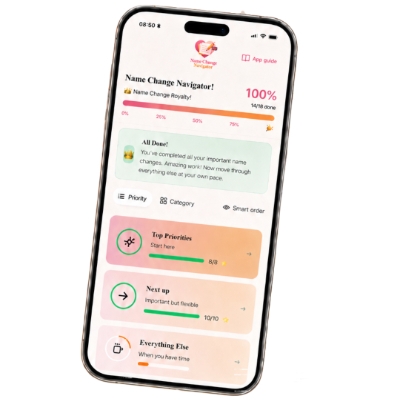
Changing your name after marriage can mean updating details with countless organisations, from banks and subscriptions to official documents and employers. New app Name Change Navigator aims to make the process easier, guiding newlyweds through each step from one platform. Founded by Rebecca Dainton, Head of Product at Flutter UK & Ireland, the app was created to reduce the stress and mental load associated with name changes. It supports a range of naming journeys, including traditional surname changes, double-barrelling, blended surnames and other choices following marriage, civil partnership, divorce or personal identity changes. The launch comes as younger generations increasingly rethink traditional naming conventions, with technology offering a more streamlined approach to this often-overlooked part of newlywed life.
READ ARTICLE
Enjoy Oystermouth Castle Outdoor Theatre This August 25th - 27th
As the sun sets over Swansea Bay, the grounds of Oystermouth Castle will become one of the region's most atmospheric performance venues this month. Outdoor Theatre returns each summer with a programme of open-air productions staged against the backdrop of the 12th-century castle, where audiences can enjoy literary classics beneath the evening sky. This year, the line-up includes Shakespeare's As You Like It, Gilbert and Sullivan's Pirates of Penzance and family-favourite 'Pinocchio'. Visitors are encouraged to bring a picnic, settle into the historic surroundings and enjoy a relaxed night of entertainment with panoramic views stretching across Swansea Bay and Mumbles. With every Outdoor Theatre ticket purchased, visitors can enjoy half price entry to Oystermouth Castle from 25th until the 27th August.
READ ARTICLE
From best mates to distant relatives: Brits reveal the wedding gift hierarchy
How much should you spend on a wedding gift? It seems the answer depends on just how well you know the happy couple. New research from One4all Gift Cards has revealed that almost half of Brits (49%) would spend less on a wedding gift if they were not particularly close to the couple. The relationship came out ahead of travel and accommodation costs (38%) and paying for a hen or stag do (28%) when it comes to factors influencing how much guests are prepared to spend. For those closest to them, Brits consider an average of £77 per person to be an acceptable wedding gift. The most popular amount was between £50 and £100, selected by 43% of respondents, while 36% believe spending up to £50 is perfectly acceptable. Just 5% would spend more than £200.
READ ARTICLE
Revealed: England and Wales’ most common wedding anniversary date as August accounts for nearly one in six
1 September is the most common wedding anniversary date, with an average of 1,557 marriages taking place on the date, new analysis has revealed. The research, from drinks and gifting retailer Bottled and Boxed, analysed 22 years of marriage registration data from the Office for National Statistics to identify the dates when couples across England and Wales are most likely to be celebrating their wedding anniversaries each year. Every date in the top 10 falls between late July and early September, showing how heavily the most common anniversaries are concentrated in late summer. August is the most common month for wedding anniversaries, accounting for 15.7% of all marriages analysed, with an average of 1,254 couples married per day.